«The World of Yesterday»: Rare Book Collection of the Library on view
Pasquale Nerino Ferri (1851-1917): one hundred years from the death of the founder of Prints and Drawings Department
- 1/13Index
Content index
Content index- 1. Index
- 2. Nerino Ferri’s art-historical education
- 3. A scientific working method: the case of «La scrittura di artisti»
- 4. The structure of «La scrittura di artisti»
- 5. The «Vasari-Milanesi» and the «Baldinucci-Ranalli» editions
- 6. Analysis of the «Lives» and the «Notes on Masters of Drawing»
- 7. Ferri’s copies of the catalogues: his irreplaceable “working tools”
- 8. Ferri’s copies of the catalogues: his irreplaceable “working tools” - 2
- 9. Ferri’s interest in photographical reproductions of works of art
- 10. International acknowledgment
- 11. International acknowledgment - 2
- 12. The first temporary exhibition of prints by Francesco Bartolozzi
- 13. Filippo Di Pietro, Nerino Ferri’s trusted collaborator
- 2/13Nerino Ferri’s art-historical education
In 1871 Nerino Ferri was a twenty-year-old student of the Florentine Academy of Arts, when Aurelio Gotti, then Director of the Uffizi Gallery, gave him a permanent job as collaborator to Carlo Pini (1805-1979), the curator of the prints and drawings in the Uffizi Gallery.
Pini first noticed Nerino Ferri while he was sketching the graphic collection of the Uffizi in order to improve his drawing skills. Pini appreciated Nerino’s dedication and talent and gave him the task of cleaning the drawings and prints and fixing the glass in their frames[1].
Ferri’s good workmanship led him to ask Aurelio Gotti to employ him as his collaborator in the rearrangement of the prints permanently on show and of the architectural drawings.
So Ferri officially entered the Uffizi “on tiptoe”[2], without a specific art history degree, carrying out technical and practical tasks. Despite this, over the years, he was able to acquire a deep knowledge of the history of art, from those whom he considered his teachers and examples: Carlo Pini and Gaetano Milanesi (1813-1995)[3].
[1] See the letter written by Carlo Pini to Aurelio Gotti, on 14th. December 1871 and published in PETRIOLI TOFANI 1983, pp. 421-422.
[2] See.FILETI MAZZA 2014, p. 136; see also PETRIOLI TOFANI 1983, p. 423.
[3] See PETRIOLI TOFANI 1983, pp. 48-50. Pasquale Nerino Ferri encouraged the development of the Prints and Drawings Department from a simple institute of conservation of works of art to a centre promoting the Uffizi graphic collection, see PETRIOLI TOFANI 1983, pp. 441-442 and FILETI MAZZA 2014, pp. 50 and the following. Apart from 1906 to 1909, when he stood in for the director of the Uffizi Gallery, Ferri officially remained, for the rest of his life, only an “inspector” of the Prints and Drawings Department (see ORBICCIANI 2007). In 1908 he sat for the public exam for the position of director of the Uffizi Gallery, but he didn’t get the job, see BCR, Archivio Ricci, particularly the letters written by Pasquale Nerino Ferri to Corrado Ricci n. 12663 “7 febbr. ‘908”, n. 12666 “Firenze 13 marzo ‘908”, n. 12670 “Firenze, 2 agosto ‘908”.
- 3/13A scientific working method: the case of «La scrittura di artisti»
The analysis of Nerino Ferri’s private collection of books, often densely annotated in their margins, shows the important role that these teachers had in his education.
Piergiacomo Petrioli’s research on Gaetano Milanesi’s artistic correspondence[4] shone a new light on the historical profile of these personalities. So Gaetano Milanesi turned out to be a true protagonist of the post Italian unification cultural scene and Carlo Pini was described as his true friend and collaborator in many scientific enterprises.
In 1830 they began visiting forgotten churches and monuments around Siena and founded the “Society for the Lovers of the Fine Arts” in 1845, together with Vincenzo Marchese (1808-1891), dominican father and Carlo Milanesi (1816-1867), Gaetano’s brother. Their first and - what turned out to be - their most important publication was the very first annotated edition of Vasari’s Lives, compiled from 1846 to 1855.
In 1866 they were chosen by the Department of Public Education to carry out a three year survey of the history of Italian miniatures.[5]
Gaetano Milanesi greatly appreciated Carlo Pini’s ability to recognise the old Masters’ personal styles[6] and often asked for his help when gathering information on the works of these artists that he had studied through historical sources[7].
Nerino Ferri learnt from Pini and Milanesi his scientific working method. It was stringent, based on reliable historical data and approached the study of artistic sources with a positivist research approach.
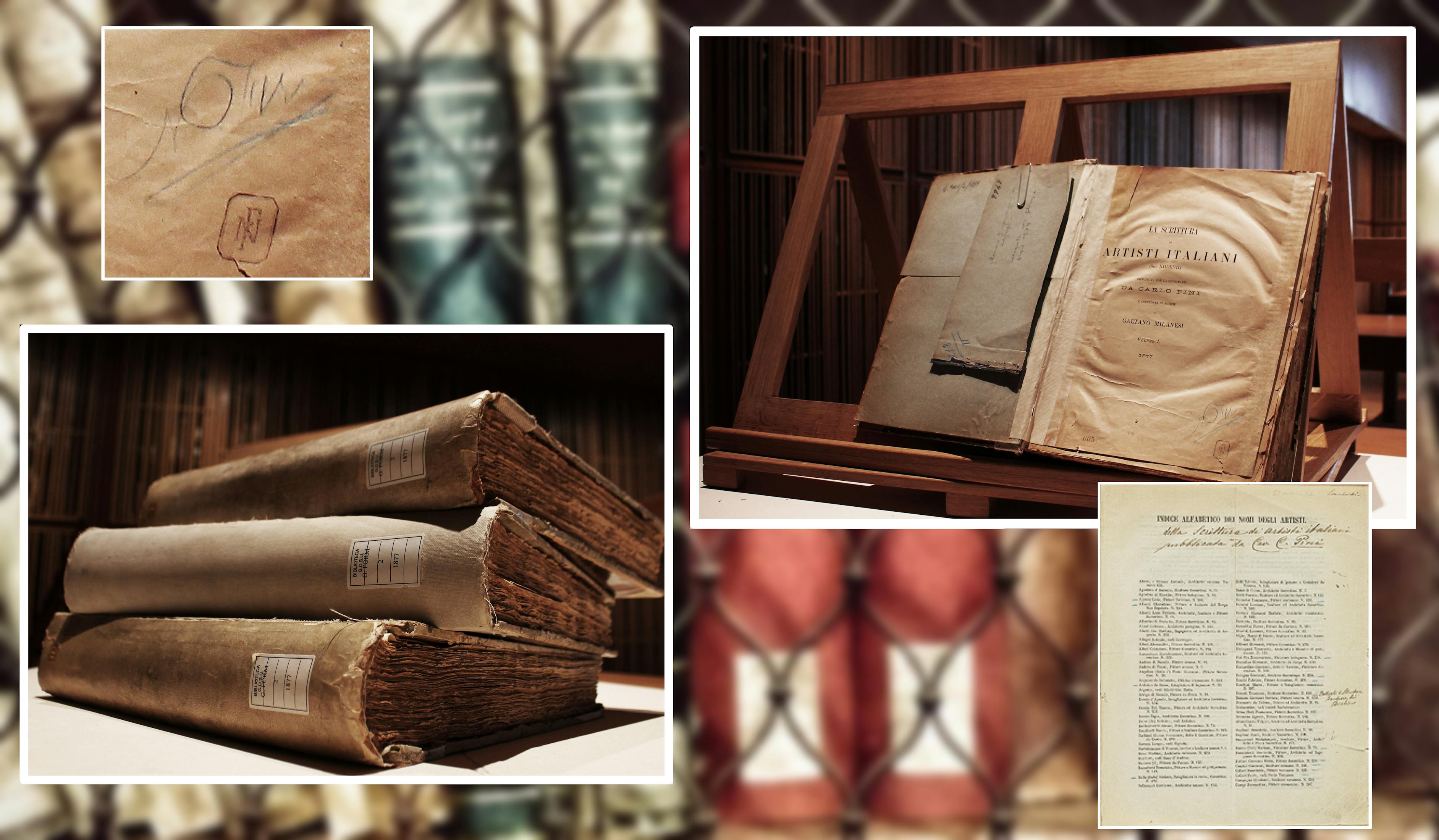
Let’s look, for instance, at La scrittura di artisti italiani, a monumental book in three volumes, that Carlo Pini published, with his own money[8], in booklets, between 1869[9] and 1876, at the end of his twenty year career as curator of the Uffizi Prints and Drawings Department. Isidoro Del Lungo wrote a very appreciative review of this book in the “Archivio storico italiano”[10].
Nerino Ferri put his personal seal on this stately edition and we can see the evidence of his reorganization of the booklets, especially in the first volume, due to his constant consultation.
[4] PETRIOLI 2004. About Carlo Pini see also FILETI MAZZA 2014, pp. 48-50.
[5] See PETRIOLI 2004, pp. 5-36.
[6] PINI / MILANESI 1876, v.1, p. VIII.
[7] In these two personalities are already evident the two fundamental aspects of the modern history of art : the archival research, referable to Gaetano Milanesi and the practical knowledge of works of art, referable to Carlo Pini. See PETRIOLI 2004, p. 3.
[8] PINI / MILANESI 1876, see also Appendix, entry n.5. In addition to this, Carlo Pini published also other books with photographic reproductions of the Uffizi drawings ( see FILETI MAZZA 2014, p. 49).
[9]In 1870 the first and second lecture notes had already been published. see DEL LUNGO 1870, p. 1.
[10] “…there are 300 autographs, divided into 12 booklets each with 25 photographic reproductions, at a cost of 20 lire”, DEL LUNGO 1870, p. 15.
- 4/13The structure of «La scrittura di artisti»
The artists’ handwriting was considered very important for the rearrangement of the Uffizi graphic collection, both as an archival source and a vestige of the artists. Carlo Pini, who carried out the photographical reproductions of the artists’ handwriting, motivated the dedication to this strange book, with this words in the preface:
“After having looked at the sketches and drawings of our most celebrated artists, it’s useful to study their handwriting, especially for the architects, who were used to writing notes between the lines of their plans. In this way many anonymous drawings could be attributed to a name”.[11]
When considered in its historical context, the work appears undoubtedly innovative[12] and not only for its use of the new photographic technique to reproduce the handwriting. Gaetano Milanesi wrote almost[13] all the artists’ biographical notes in a dry, linear style, refusing to give room to rethorical and inflated digressions, often present in artistic literature of the time.[14]
The most important thing was the historical reliability of this information, based on the stringent analysis of the archival sources, done by the most discerning artistic storiographers, mainly German. Some exponents of this new tendency – Gaye[15], for instance – were expressely cited in the Preface[16].
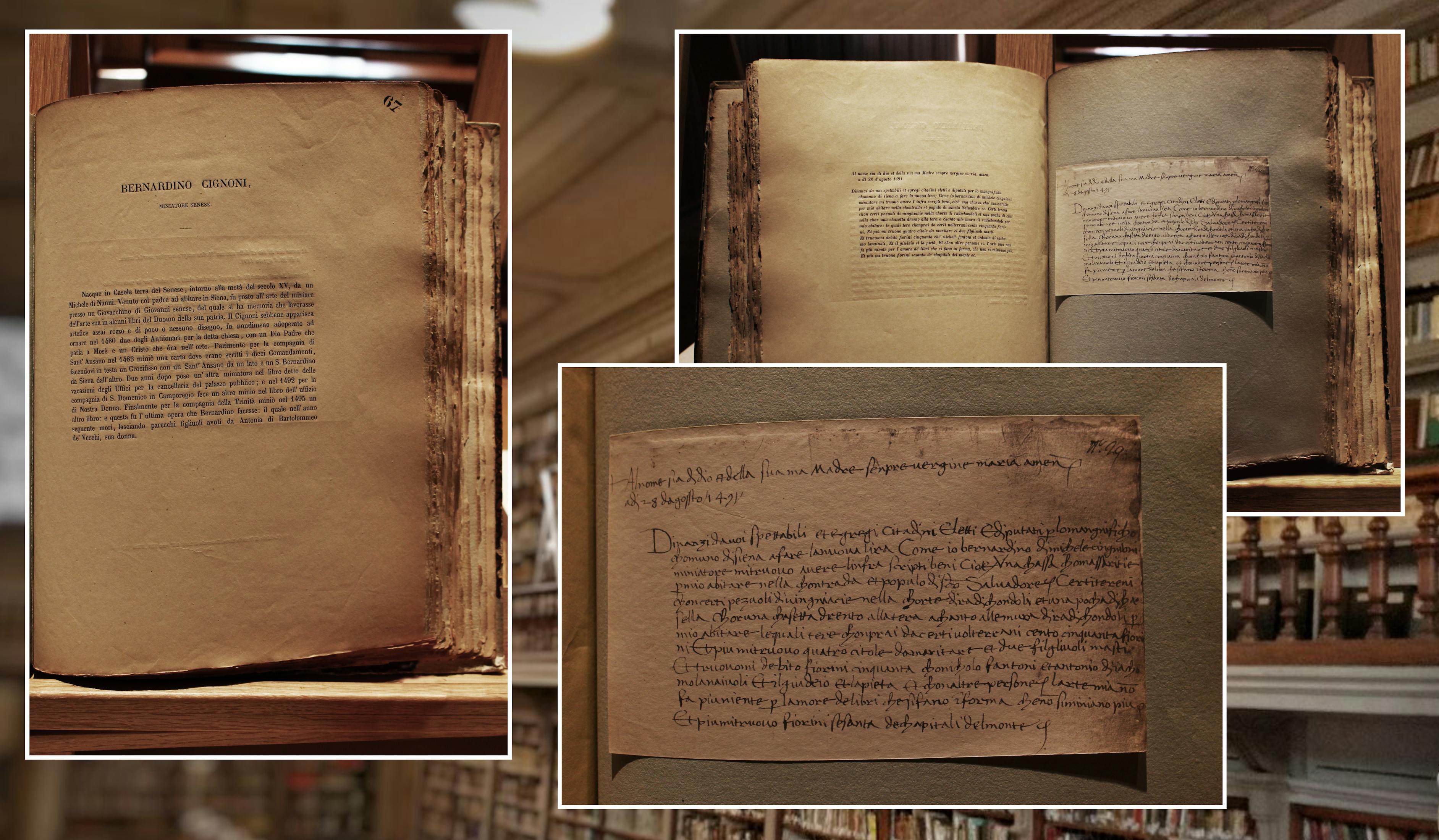
Each artist had attached biographical information and photographic reproductions of archival documents, such as cadastral documents, commissions for works of art, fee receipts and full transcriptions of the documents themselves. Some documents were already published elsewhere[17], but most of them were unpublished at the time.
La scrittura di artisti italiani was appreciated especially for the vast quantity of information, not only about painters, sculptors and architects, but also about illuminators, carvers and goldsmiths, etc. Gaetano Milanesi and Carlo Pini probably included in this work, at least in part, the results of the research they had carried out in forgotten churches, libraries and archives over a large area of Central Italy, from 1866 through to 1869, in the wake of the Italian Unification. In fact, on behalf of the Ministry of Public Education, they were given the task of writing a history of Italian illumination, in order to protect these works of art, until then not appreciated for their artistic value[18].
[11] See C.PINI, Prefazione in PINI / MILANESI 1876,v.1.
[12] See FILETI MAZZA 2014, p. 49.
[13] Except for the note about Giovanni di Gherardo da Prato (n.17, vol.1) written by Cesare Guasti ( see.SARTI 2010).
[14] See PETRIOLI 2004, pp. 16-17.
[15] The German Giovanni Gaye was the editor of Carteggio inedito d’artisti dei secoli XIV, XV, XVI, 3 v. Firenze 1839-1840. See PETRIOLI 2004, pp. 23-24.
[16] C.PINI, Prefazione in PINI / MILANESI 1876, v.1.
[17] Documents were already published mainly in MILANESI 1854-1856 and in GAYE 1839-1840.
[18] This enquiry was never published. See PETRIOLI 2004, pp. 136-157.
- 5/13The «Vasari-Milanesi» and the «Baldinucci-Ranalli» editions
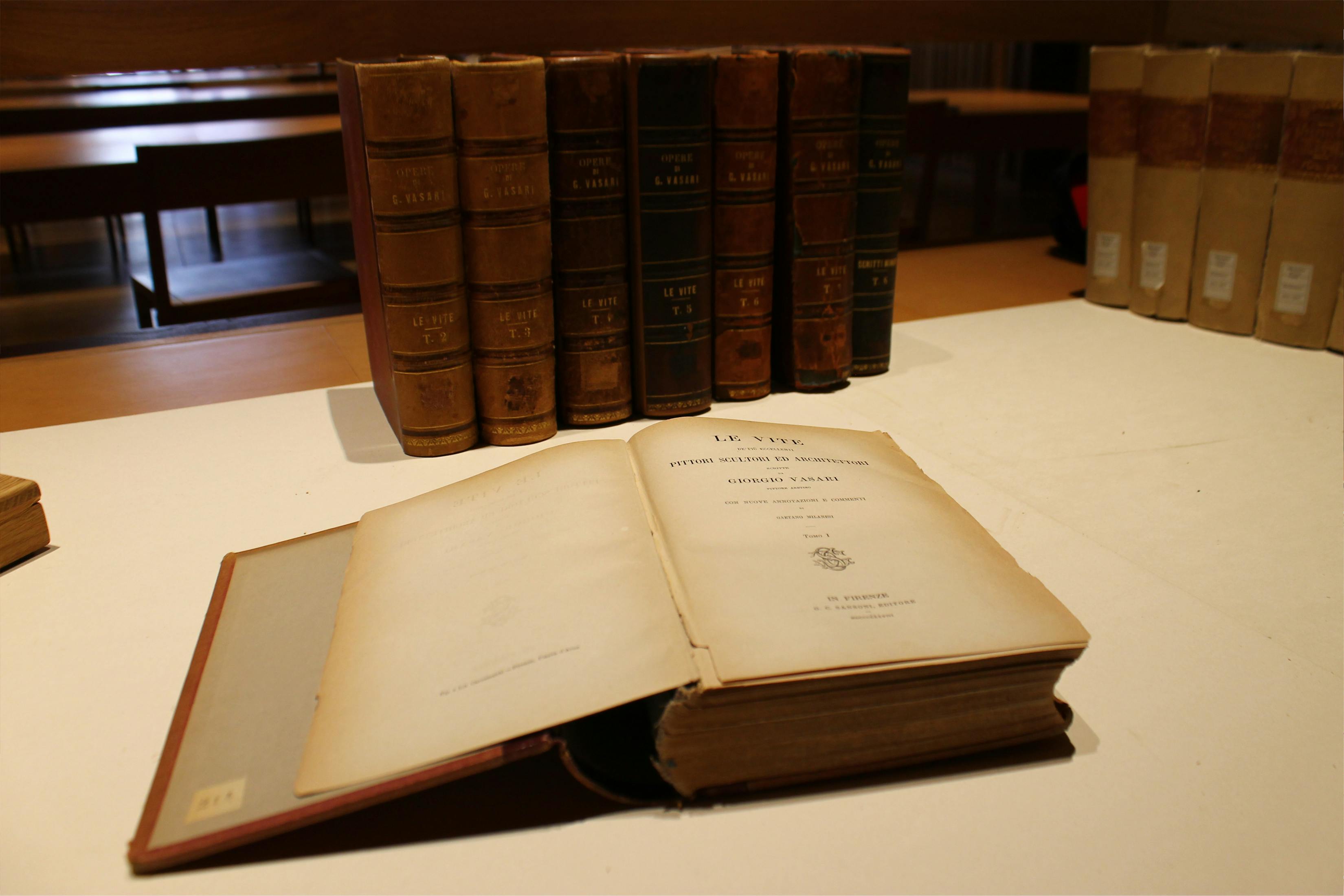
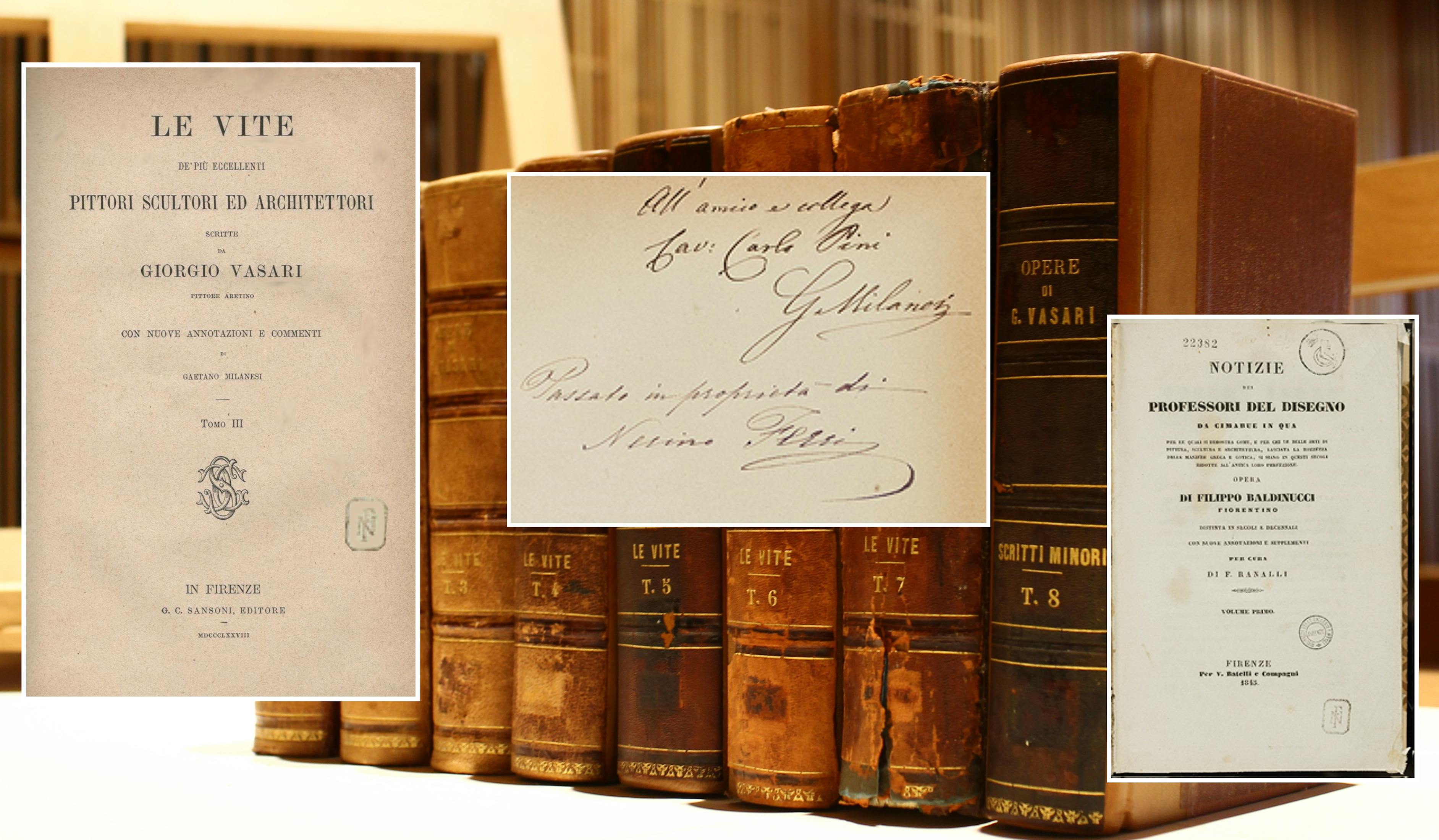
Ferri’s constant referencing to Gaetano Milanesi is also evident in his analysis of Milanesi’s historical edition of Vasari’s Opere, published in booklets from 1878 to 1885, including Vasari’s Lives of the artists, that was part of Nerino Ferri’s collection. We can see how important this edition of Vasari’s Lives was to Ferri, when we note Ferri’s decision to have his volumes bound, adding his initials “n.f.”, in the centre of the front covers.[19]
Through the notes and dedications handwritten in the different volumes of this edition, we see that Ferri acquired them as a gift from Carlo Pini, who received them, in turn, from his “friend” Gaetano Milanesi.
[19] VASARI / MILANESI 1878-1885, see also the Appendix, entry n. 9.
- 6/13Analysis of the «Lives» and the «Notes on Masters of Drawing»
This “Vasari-Milanesi” edition, so called and well known by the scholars of the time, was immediately considered as an obligatory point of reference for historical art researchers. In fact it was most appreciated both for Milanesi’s stringent historical style, used to verify the reliability of the information written in Vasari’s Lives and for the citations and the transcriptions of a vast quantity of archival documents, articles in specialized reviews, new studies and observations collected by Milanesi himself over the years.[20]
In Nerino Ferri’s copy, the indexes of the artists’ names at the end of the eight volumes have many handwritten references to the previous “Vasari-Le Monnier” edition, evidently very well known by Ferri and edited by the “Society for the Lovers of the Fine Arts”[21].
Ferri also frequently consulted the Notizie de’ professori del disegno, first published by Filippo Baldinucci in 1681, after he reorganized cardinal Leopoldo de’ Medici’s collection of drawings, the core of the Uffizi graphic collection[22].
The handwritten notes in the margins of the text tell us that these volumes were often consulted by Nerino Ferri during his reorganization and scientific classification of the Uffizi prints and drawings collection. These volumes, owned by Ferri and Count Carlo Gamba (1870-1963)[23], come from the fifth edition of Baldinucci’s Notizie, edited by the estimed historian and literary scholar Ferdinando Ranalli (1813-1894)[24], who thought that a “puristic” renewal of art was necessary, following the example of the great Fourteenth and Fifteenth century Masters[25].
This new art movement led to the re-publication of Baldinucci’s work on the old Masters, the well-known “Vasari-Milanesi” edition[26] and other books about the lives of those artists.
[20] See PETRIOLI 2004, p. 95. See also BAROCCHI-MILANESI 1906/1973, pp. IX-XVII.
[21] See PETRIOLI 2004, pp. 75-94.
[22] BALDINUCCI / RANALLI 1845-1847, see also Appendix, entry n. 2. After Baldinucci,’s death (1697), his son Francesco Saverio continued the publication of the work until his death in 1738. See FILETI MAZZA 2009, p. 33.
[23] Count Carlo Gamba was an art collector and one of Ferri’s close collaborator in the monumental edition DISEGNI DELLA GALLERIA 1912-1921, see TODROS 1989 and, recently, MASINI 2014 and MASINI 2015.
[24] Ranalli (1813-1894) was a historian, literary man and politician, see BAROCCHI 1990-1998, p. 713.
[25] See PETRIOLI 2004, pp. 103-115. See also BAROCCHI-MILANESI 1973, pp. IX-X.
[26] In the same period Ranalli also published an annotated edition of Vasari’s Lives (1845-1848) and a history of fine arts in Italy (Firenze, 1848), see BAROCCHI 1990-1998, p. 713.
- 7/13Ferri’s copies of the catalogues: his irreplaceable “working tools”
Nerino Ferri’s artistic education went hand in hand with the revision of the published catalogues and the publication of new inventory tools, such as the Catalogo delle stampe vendibili presso la nobil famiglia Zuccardi Merli in Correggio d’Emilia[27]. Compiling this catalogue was one of the first tasks that Nerino Ferri performed on behalf of the Uffizi Gallery[28], when he was only twenty-three years old. On that occasion, Count Angelo Zuccardi Merli gave Nerino the gift of an extract on the engraving of prints from Francesco Milizia’s (1725-1798)[29] Dizionario delle arti del disegno, that can be considered almost a viaticum for the specialised career Ferri was about to undertake[30].
In 1886, before Ferri became Pini’s collaborator, the sculptor Emilio Santarelli (1801-1886) donated his personal collection of 12,461 drawings to the Uffizi Gallery. He also compiled the catalogue[31] of his collection together with the painters Emilio Burci[32] (1811-1877) and Ferdinando Rondoni[33] (1808-1880), both inspectors at the Superintendance of the Royal Galleries in Florence and authors of similar books[34].
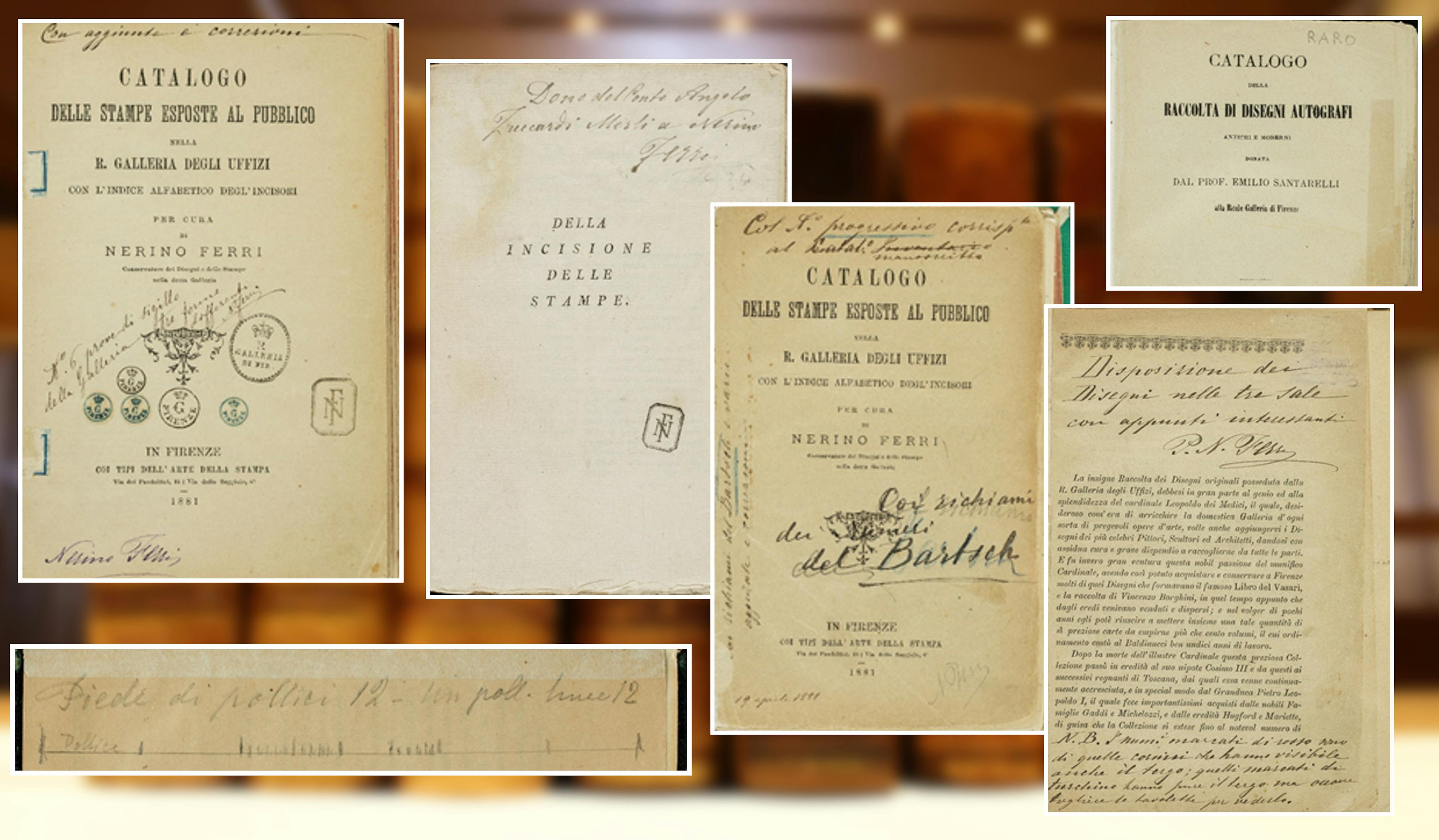
Nerino Ferri broke up and newly bound his copy of the Catalogo della raccolta di disegni autografi, antichi e moderni donate dal prof. Emilio Santarelli alla Reale Galleria di Firenze, published in 1870, inserting over [875] blank pages between the printed pages; on these white pages Ferri wrote down dense notes concerning his hypothesis of the attributions of the works of art, almost doubling the volume of his copy.
In fact, Ferri was aware that his catalogue was a “work in progress” and that, even after publication it should continue to be critically reviewed, especially concerning the investigations into the true authorship of the works of art in the Uffizi Gallery [35].
And so these copies of the catalogues can be seen as unique witnesses of Ferri’s great undertaking and they allow us to follow his work step by step. This is exactly what Miriam Fileti Mazza did while writing her complex history of the Uffizi art collection from the Napoleonic Age to the First World War[36].
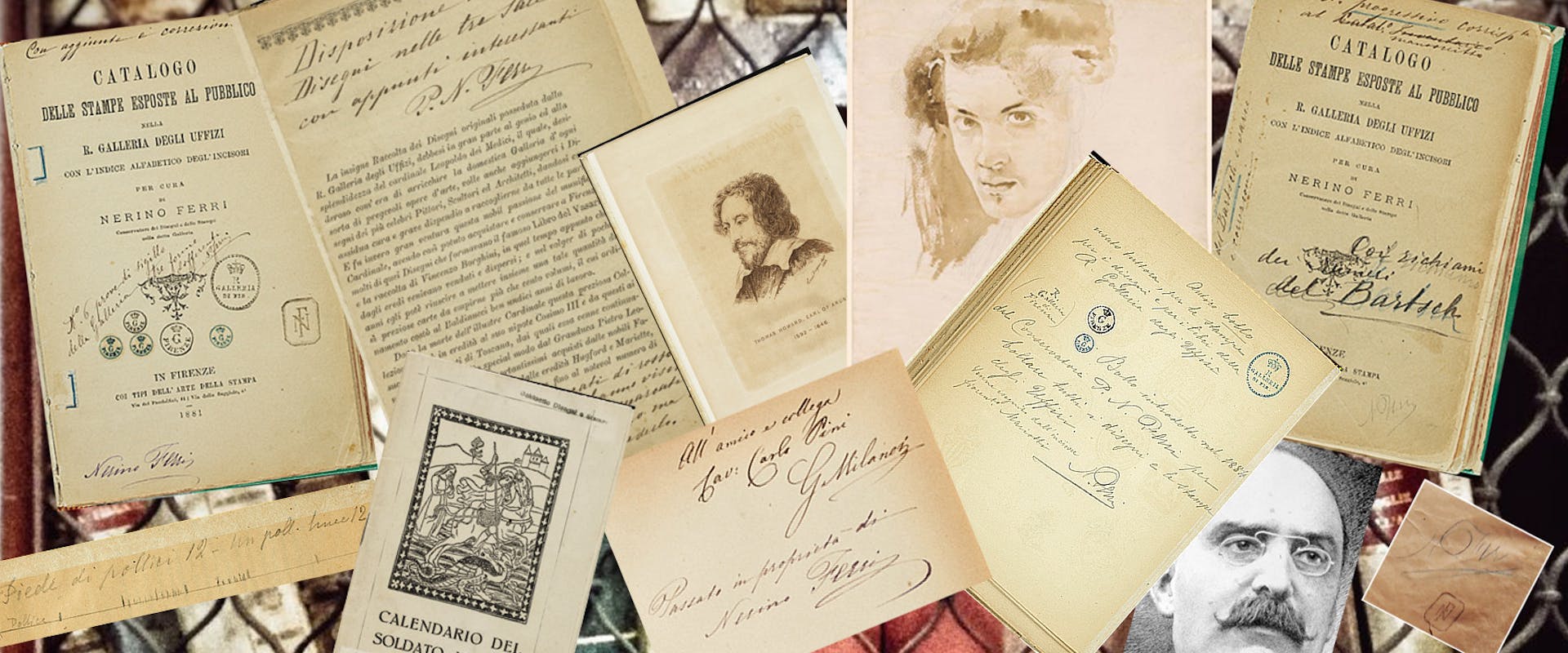
In her opinion, Ferri derived his descriptive method of prints and drawings directly from Carlo Pini, who, in 1873, worked on the compilation of a very accurate and detailed manuscript version[37] of a catalogue of the prints and drawings permanently on show[38] at the Uffizi Gallery. Ferri’s Catalogo delle stampe e disegni esposti al pubblico nella R. Galleria degli Uffizi, published in 1881, was actually only an abridged version of the manuscript catalogue compiled by Carlo Pini.[39]
The prints and drawings were separated into two sub-catalogues, with different page numbers in order to be sold as either one volume or divided into two[40].
If we look at Ferri’s various copies of the complete Catalogue[41], we can immediately see that Ferri used them as real “working tools”[42], each one with a different function.
Ferri used one of his copies of the Catalogo dei disegni esposti al pubblico to check which works of art could also be seen from behind and when it was necessary to “take off the back covers. [43].
He compiled another useful copy, inserting [99] pages in the place of the printed pages of the sub-catalogues, and used this copy to reference the Bartsch’s numbers of the works of art described in the well known Adam Bartsch’s repertoire, Le peintre graveur .[44]
He also used this copy to consult the manuscript Index of the Artists’ masterworks from which the engravings are taken and to measure the works of art in inches using his own hand-written ruler drawn on one of the white pages in the back.
Ferri used the front page of another copy of the Catalogo delle stampe esposte al pubblico to try out the six newly designed Gallery stamps with three different shapes[45].
Fileti Mazza believes that, in this last copy of the Catalogo, we can see the transition towards an advanced method of Ferri’s classification of the Uffizi works of art[46].
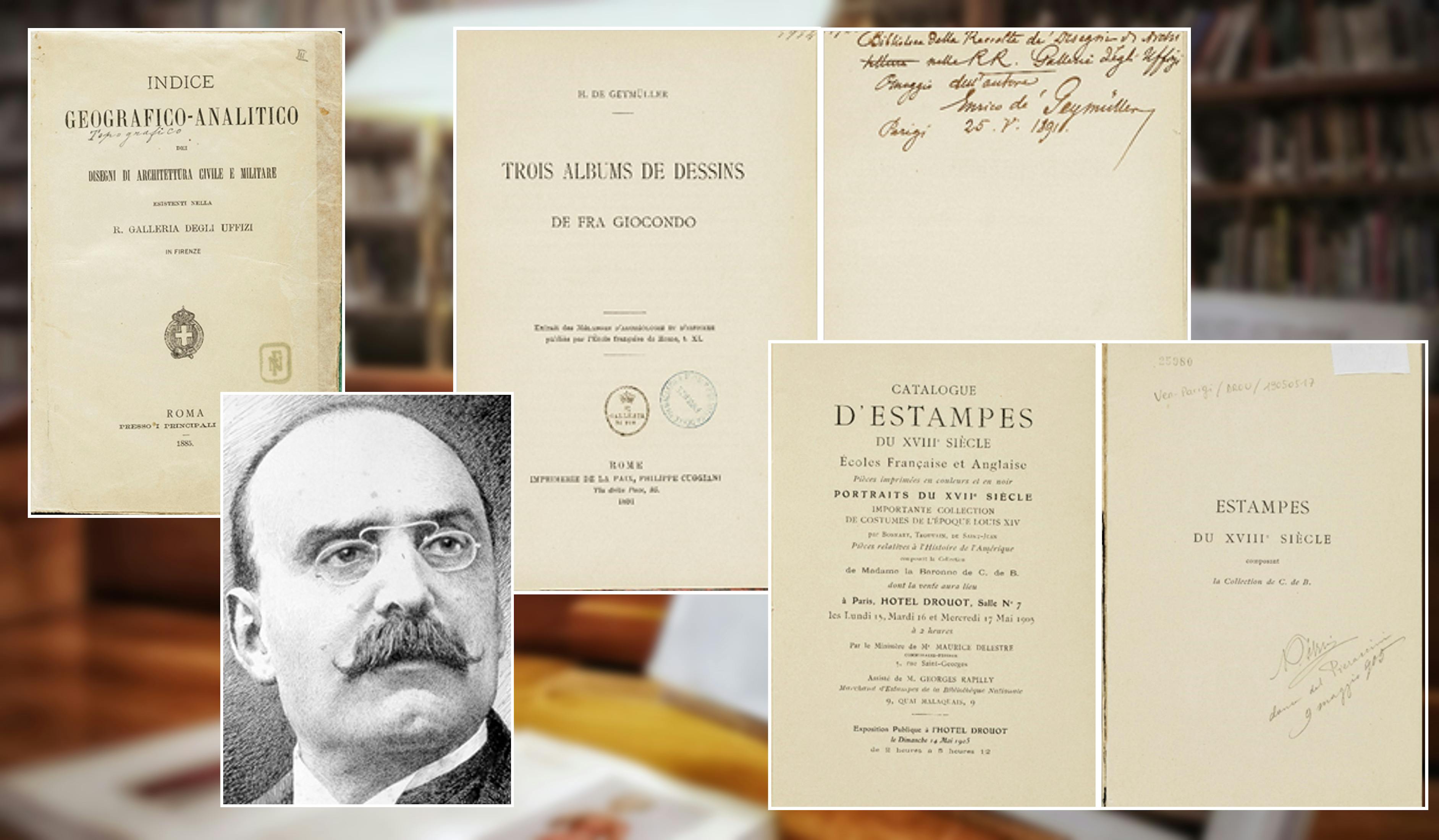
She also considers the copy of Indice geografico-analitico dei disegni di acritettura civile e militare esistenti nella R. Galleria degli Uffizi, with its [470] pages interplaced between the printed pages, all densely annotated by Ferri and his successors[47], as “an irreplaceable document that was still being added to until the early XXth. century”[48].
[27] FERRI 1874. A handwritten note, initialled “N. F.” [NerinoFerri], is handwritten on the cover of the copy in the Uffizi Library : “Catalogue written by me from the 1st. June to the 5th July 1874 in Correggio. Nerino”.
[28] See FILETI MAZZA 2014, p. 57
[29] MILIZIA 1797, see also Appendix, entry n. 1.
[30] Francesco Milizia (1725-1798) was an obligatory point of reference for XIX century drawing and print experts, see BAROCCHI 1990-1998, p. 710.
[31] SANTARELLI 1870, see also Appendix, entry n. 4. For information relating to Santarelli’s donation, see FILETI MAZZA 2014, pp. 52-53.
[32] See PITTALUGA 1974.
[33] See RENZONI 2010.
[34] Other Burci’s works are a catalogue of the Uffizi Gallery in French (E. BURCI, G. CAMPANI, Première et seconde partie du catalogue de la R. Gallerie de Florence, Florence, 1860) and an artistic guide of Florence, reviewed and annotated by P. FANFANI (Firenze-Roma 1875), see PITTALUGA 1974, p. [3]. Rondoni was also the author of a guide to the S. Marco Museum in Florence ( Firenze, Tip. Cenniniana 1872).
[35] See PETRIOLI TOFANI 1983, p. 434.
[36] See FILETI MAZZA 2014.
[37] GDSU, Fondo manoscritti, coll. n. 68-69. See FILETI MAZZA 2014, pp. 56-57.
[38] The most beautiful prints and drawings at the Uffizi Gallery were permanently on show from 1854 to 1909, when the Uffizi Gallery organized the first temporary exhibition of drawings. See FILETI MAZZA 2014, pp. 44-120, PETRIOLI TOFANI 1983, FORLANI TEMPESTI 1980 and FORLANI TEMPESTI 1972.
[39] FERRI 1881, See FILETI MAZZA, p. 56
[40] FERRI 1881, see also Appendix, entry n. 7a
[41] FERRI 1881, see Appendix, entry n. 7a, 7b, 7c.
[42] See FILETI MAZZA 2014, pp. 62-63, particularly the note 292.
[43] FERRI 1881, see Appendix, entry n. 7b.
[44] BARTSCH 1803-1821.
[45] FERRI 1881, see Appendix, entry n. 7c.
[46] In her opinion it is strange to find this advanced method in manuscript form and not in a printed version, see FILETI MAZZA 2014). The manuscript is now edited in Ivi, Appendice XXVI.
[47] FERRI 1883
[48] See FILETI MAZZA 2014, pp. 72-73.
- 8/13Ferri’s copies of the catalogues: his irreplaceable “working tools” - 2
Baron Heinrich de Geymüller (1839-1909) was a drawing collector, well known, at the time, for his Die ursprünglichen Entwürfe für Sanct Peter in Rom[49]. He also studied the Uffizi architectural drawings, working well with Carlo Pini and, afterwards, with Nerino Ferri in the classification of these drawings[50].
On the 25th of May, 1891, Geymüller donated an essay entitled Trois albums de dessins de Fra’ Giocondo[51] to the Uffizi library. Ferri bound it with another Geymüller essay entitled Cento disegni di architettura d’ornato e di figure di Fra’ Giovanni Giocondo[52].
This gift is proof of the intensive collaboration between Geymüller and Nerino Ferri that brought with it considerable mutual cultural enrichment. With this in mind, Geymüller wrote:
“…I’m pleased to declare that some of the most interesting of these drawings were recognised by Nerino Ferri, the curator of the prints and drawings in the Royal Medici Gallery called Uffizi. He was Carlo Pini’s worthy successor and he has assisted us with tireless eagerness, courtesy and friendship…”[53].
This collaboration led to Ferri’s acquisition of Baron Geymüller’s important collection of architectural drawings, that arrived in the Uffizi in 1907 together with Count Bernardino Campello’s drawing collection[54].
From 1903 to 1906 Corrado Ricci (1858-1834) directed the Uffizi Gallery and collaborated with Nerino Ferri on the enlargement of the prints and drawings collection [55]. In the early 20th century Ferri began to collect sales catalogues, important “working tools” that helped him to follow the trend in the international market of prints and drawings.
The proof is a small sales catalogue of an auction held in Paris at Hȏtel Drouot in May 1905, donated to Ferri by his colleague Eugenio Pieraccini[56]. It was a sales catalogue for a collection of XVII century portraits and a collection of costumes from the “Louis XIV” period.
[49] GEYMULLER 1875-1880.
[50] See PLODER 2006.
[51] GEYMULLER 1891, see also Appendix, entry n. 16.
[52] GEYMULLER 1882
[53] GEYMULLER 1882, p. 14. The Uffizi Library owns the copy of this booklet, that belonged to Pasquale Nerino Ferri. Geymüller dedicated this copy to Ferri as a “memory of grateful friendship”.
[54] See PLODER 2006, pp. 50-51, FILETI MAZZA 2014, pp. 71-72. See also FERRI 1908.
[55] See FAIETTI 2006, p. X.
[56] BONNART 1905, FERRI 1881. See also Appendix, entry n. 23. Eugenio Pieraccini was vice-director of the Uffizi Gallery in the 1890s.
- 9/13Ferri’s interest in photographical reproductions of works of art
As the most beautiful prints and drawings of the collection were permanently on show at the Uffizi Gallery, the public interest in their photographic reproductions was ever on the rise.
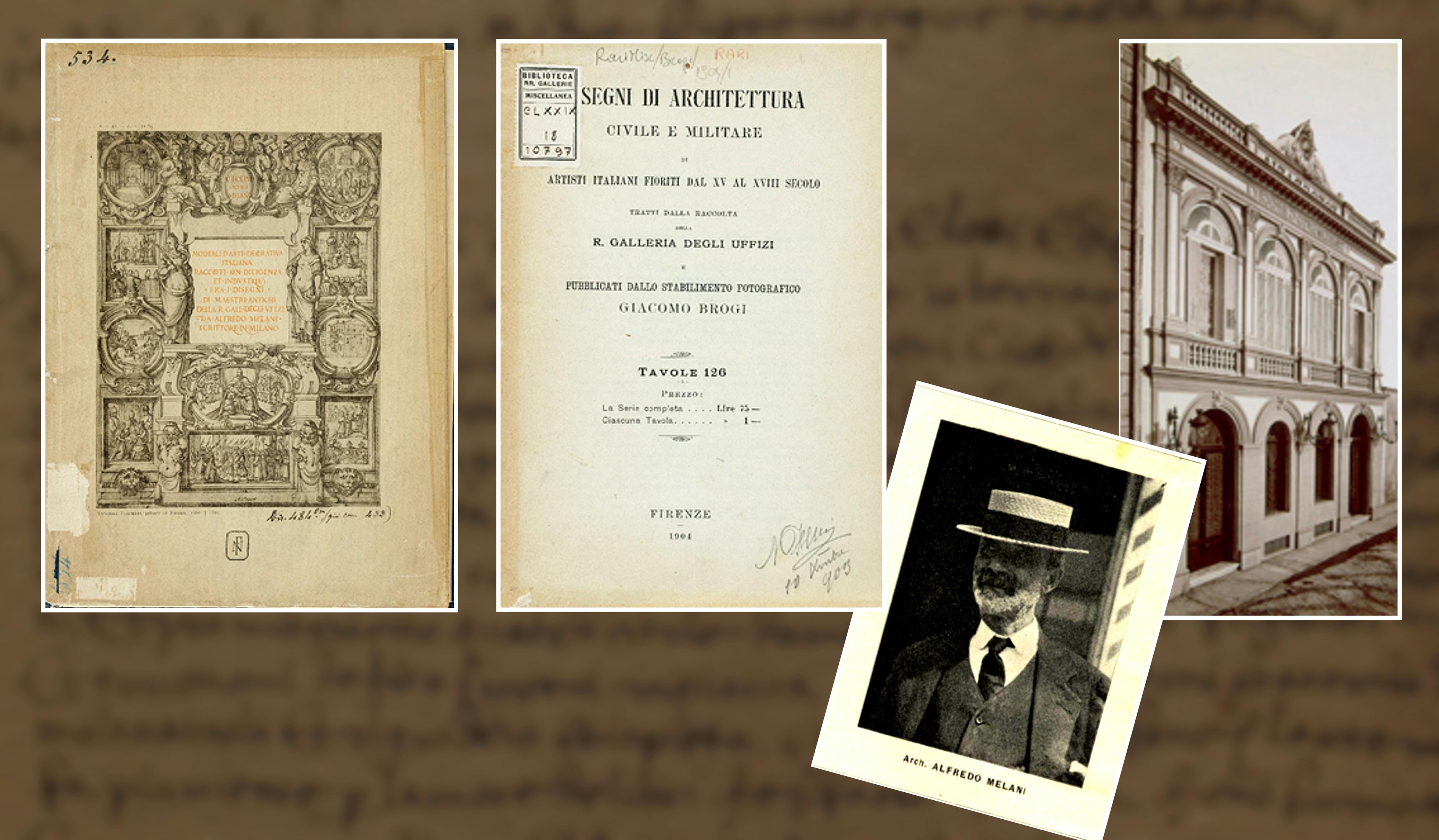
In 1882 the architect Alfredo Melani (1859-1928) began teaching “Drawing” at the Technical Institute for Art in Industry in Milan[57].
In 1898 he published Modelli d’arte decorativa italiana, with 50 photographic reproductions of ornamental drawings from the Uffizi with his students in mind. He underlined the importance of Ferri’s classification of drawings:
“The drawings reproduced in this collection are mostly unpublished and were mainly chosen from among those permanently on show in the recent classification of old drawings preserved in the Royal Uffizi Gallery. They were recently found in the archives and were thus unknown and were photographed on purpose.”[58]
He had always followed this new technique with interest. Photographic reproductions of works of art from the Uffizi Gallery began in the 1860s, well before Nerino Ferri started working there. Carlo Pini, Nerino Ferri’s teacher, was also enthusiastic about this new medium.[59]
This is the reason why Ferri owned a number of booklets about Giacomo Brogi, the founder of one of the most famous photographic studios in Florence at the time [60]. In 1879 Brogi’s studio published the Catalogue de photographies[61] with a list of titles of many Uffizi drawings, available as photographic reproductions, in various formats and marketed to the international customers in his shops in Florence, Naples and Rome.[62]
In 1904 Brogi’s studio published 126 reproductions of Disegni di architettura civile e militare di artisti italiani fioriti dal XV al XVIII secolo, together with an attached index of the works of art reproduced. Nerino Ferri owned a copy of this index but he gave all the reproductions to the Uffizi Photographic Cabinet, founded in 1904 by Corrado Ricci in order to establish an archive of existent photographs and to continue the photographic reproduction of the Uffizi works of art [63].
[57] See MAESTRELLI 2001, pp. 93-95.
[58] See MELANI 1898 and FERRI 1881. See also Appendix, entry n. 21. This text is taken from the advertising printed on the pink tissue paper that is wrapped around the photographic reproductions of the drawings, in the copy found in the National Library in Florence.
[59] See FILETI MAZZA 2014, pp. 47-48.
[60] The Uffizi Library has Ferri’s copies of ARBIB 1882, GAMBERUCCI DA PRATA 1882 and BROGI 1904.
[61] BROGI 1878.
[62] See SILVESTRI 1994.
[63] TAMASSIA 2011, pp. 16-20.
- 10/13International acknowledgment
Ferri’s Catalogo delle stampe e disegni esposti al pubblico, published in 1881, earned him the right to be part of the international élite of experts, dedicated to the specific sector of prints and drawings.
We can acquaint ourselves with some of these interesting personalities through the analysis of the books received by Nerino Ferri after the 1880s and, especially, through their dedications. These people often added expressions of esteem for him in their signed dedications. Some of these colleagues became part of this world because they were artists and engravers, whilst others were important collectors, art historians and very wealthy businessmen who gave impetus to the foundation of some of the most famous museums in the world.
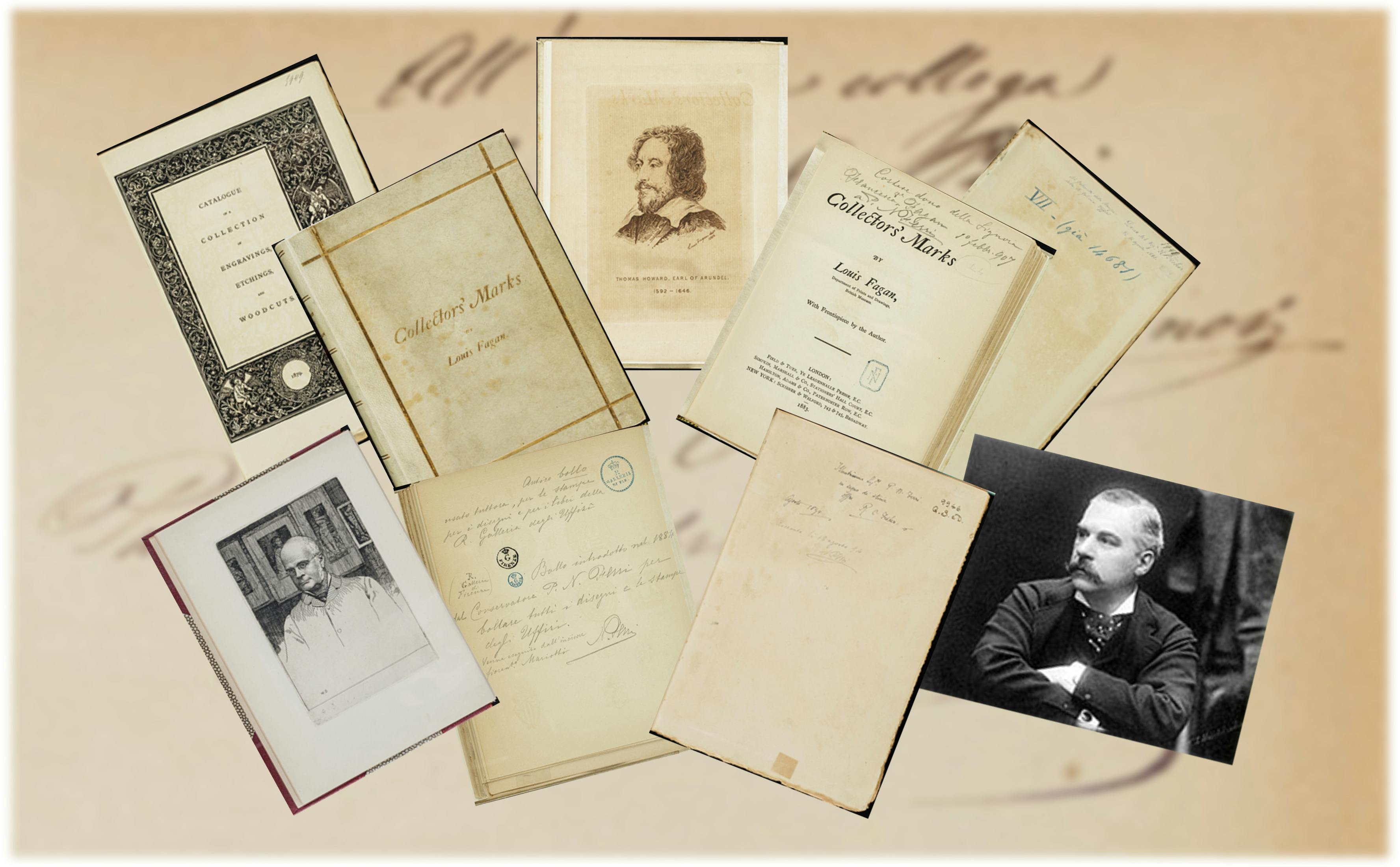
Louis Alexander Fagan (1845-1903) was an English diplomat’s son, born in Naples in 1845. He was an art historian and also an esteemed engraver, especially of portraits. In his life he was able to combine his passion for art with his love of travelling, inherited from his parents[64].
From 1869 Fagan became the curator of the Prints and Drawings Department of the British Museum in London. In 1876 he published a guide of this museum[65]. In 1883 he became well-known for his publication of the Collector’s Marks[66], a repertoire of 668 collection stamps made up of small ink and dry stamps and inscriptions, used by collectors to identify their prints and drawings.
Fagan’s Collector’s Marks preceded Frits Lugt’s extensive repertoire Les marques de collections de dessins & d’estampes, published in 1921[67]. In comparison to Lugt’s repertoire, Fagan’s Collector was little more than “a sketch”[68], but it was similar to Lugt’s work in many aspects.
For each stamp, Fagan indicated the biographical notes of the collector, the property transfers of the collection, any sales at auction houses and the price for which the collection was eventually sold.
As Fagan explained in his preface, his Collector’s Marks was the result of years of research conducted in England and in other European countries thanks to the collaboration of ”friends and colleagues”, such as Pasquale Nerino Ferri and many others. Louis Fagan cited all these collaborators at the end of his preface, asking them to fill in the empty spaces he had left next to collector’s stamps with unknown origin.
In the list of Ferri’s friends and colleagues[69], we can find names such as: Friederich Lippman (1838-1903), who was the curator of the Museum of Prints and Drawings in Berlin, Pierre-Paul Both de Tauzia (1823-1888), the curator of the Louvre Museum in Paris, Moriz Thausing (1835-1884), the then director of the Albertina Gallery in Vienna, Georges Duplessis (1834-1899), curator of the prints of the National Library in Paris, Henri Hymans (1836-1912), curator of the Royal Library of Belgium, Adolfo Venturi (1856-1941), the well-known art historian who was curator of the Estense Gallery in Modena in 1878, Richard Fisher (1809-1890), collector and scholar of his own personal collection of engraved books and prints and Alphonse Wyatt Thibaudeau (1840-1892), the renowned dealer in rare books and prints [70].
Louis Fagan, towards the end of his life, probably had the opportunity to meet Ferri personally when he came to Florence in 1894 due to health problems, remaining until his death in 1903.
In 1907 Madame Francesca Fagan, Louis Fagan’s widow, gave Nerino Ferri a copy of her husband’s Collector’s Marks[71], in which Ferri then wrote some notes and added “the examples of stamps used for the Uffizi collections”, together with his signature.
Madame Fagan also gave two other remarkable books[72]: Bartolozzi and his works, written by the Londoner publisher and art expert Andrew Tuer in 1885 and Twenty-Nine Drawings by Agostino Busti called Bambaia, published in 1887, in only ten copies and given to Louis Fagan by Friederich Lippmann, the then director of the Museum of Prints and Drawings in Berlin.
In 1879 the wealthy collector and scholar Richard Fisher, “gentleman of West Sussex”, published his personal collection of Italian, German, Spanish, French, Flemish and English engraved books and prints from the XVth to the XVIth century and donated a first edition of this book to the Uffizi Library in 1881[73].
He called his book simply Catalogue of a Collection of Engravings and he did not reveal his name on the frontispiece, as a sign of modesty and discretion[74].
Richard Fisher wrote well documented historical essays in his Catalogue[75]. Through his son “R.C. Fisher”[76], known only by his initials, he got in touch with the well-known historian Gaetano Milanesi, in order to ask him for information about the goldsmith Maso Finiguerra, who Vasari indicated as the inventor of the engraving technique in his Lives[77].
The second copy of Richard Fisher’s Catalogue came to the Uffizi Library much later, in 1894, donated by his son, “R. C. Fisher”, and dedicated personally to Nerino Ferri “as a sign of appreciation”[78].
Richard Fisher became a well-known scholar of Italian engravings, so much so as to write a book of great relevance on this subject in 1886: Introduction to a Catalogue of the Early Italian Prints in the British Museum.[79]
Only in 1909 and 1910 did Arthur Mayger Hind finally publish his catalogue of the Italian drawings in the collection of the British Museum, a publication that is still a key point of reference in this sector[80].
The wealthy Baron Adalbert von Lanna (1836-1909)[81], builder of ships and railways, donated a catalogue of his collection of drawings and prints to the Uffizi Library in 1896, “hoping that it would be well received”.[82] He entrusted the writing of his catalogue to Wolfgang Singer.
Singer was an art expert and engraver[83], probably the artist responsible for the portrait of Baron von Lanna, on the page opposite the frontispiece[84] of the catalogue.
Just as John Pierpont Morgan[85] in the United States, Baron von Lanna collected heterogeneous art objects, such as chinaware, sculpture, bronzes, antique furniture, medals, coins, enamelware and glassware.
Frits Lugt[86] believed that Baron Von Lanna’s passion for prints and drawings was born after he purchased a large polychrome jug, decorated with scenes taken from the engravings of “War Miseries” by Jacques Callot. He then purchased a number of Jacques Callot’s works of art and enriched his collection with drawings and prints by other Old Masters, such as Dürer and Rembrandt, building up one of the largest art collections of the second half of the XIXth century.
Baron von Lanna donated his vast collection of glassware and a large part of his art collection to the Museum of Decorative Arts in Prague, a museum he helped found in 1885.
[64] See THIEME-BECKER 1915, vol. 11, p. 188.
[65] FAGAN 1876. The Uffizi Library has a copy of this book with a handwritten dedication on the frontispiece: “To the honourable Mr. Nerino Ferri, the Author 1881”.
[66] FAGAN 1883, FERRI 1881. See also Appendix, entry n. 8.
[67] LUGT 1921. It was followed by LUGT 1956.
[68] See LUGT 1921, p. VII.
[69] See FAGAN 1883, pp. [III]-V. For the following biographical notes see DAH 2000, at the entries.
[70] About Richard Fisher, see LUGT 1921, n. 2204-2205; about Alphonse Wyatt Thibaudeau, see LUGT 1921, n. 2473.
[71] FAGAN 1883, see Appendix, entry n. 8.
[72] TUER 1885, see Appendix, entry n. 13 and LIPPMANN 1887, see Appendix, entry n. 14.
[73] About Richard Fisher and his collection, see LUGT 1921, n. 2204-2205.
[74] The name of the curator is indicated at the foot of the preface. Here Fisher wrote: “the collections of engravings described in the following Catalogue are scarcely of sufficient importance to justify the publication”. See FISHER 1879, p. [iii], see also Appendix, entry n. 10a.
[75] See FISHER 1879, pp.[1], [123], [227], [265], [309].
[76] “R.C. Fisher” often came and stayed in Florence, was fluent in Italian and frequented the society of English intellectuals living in the city. He knew Gaetano Milanesi very well and asked him for information also on behalf of the British Museum officials. To this end see his letters to Gaetano Milanesi, signed “R.C. Fisher”, in PETRIOLI 2004, entries n. 337-342, pp. CCXXII-CCXXVI and see also MILANESI CARTEGGIO.
[77] See FISHER 1879, pp. 2-3. See also PETRIOLI 2004, pp. CCXXII-CCXXIII, n. 337. “R.C. Fisher”, sent this letter from Florence on 14th May 1880. Here he thanked Gaetano Milanesi ,on behalf of his father, “ for the information given with so much courtesy about Maso Finiguerra”, and donated the other copy of Richard Fisher’s Catalogue to the Uffizi Gallery (see FISHER 1879, Appendix, entry n. 10b).
[78] see FISHER 1879, Appendix, entry n. 10b.
[79] FISHER 1886. See also LUGT 19121, n. 2204-2205.
[80] HIND 1909-1910.
[81] About Adalbert von Lanna, see LUGT 1921, n. 2773.
[82] SINGER 1895, see also Appendix, entry n. 17.
[83] See LUGT 1921, n. 2773.
[84] SINGER 1895, see also Appendix, entry n. 17.
[85] See SCIOLLA 1992, ad vocem.
[86] See LUGT 1921, n. 2773.
- 11/13International acknowledgment - 2
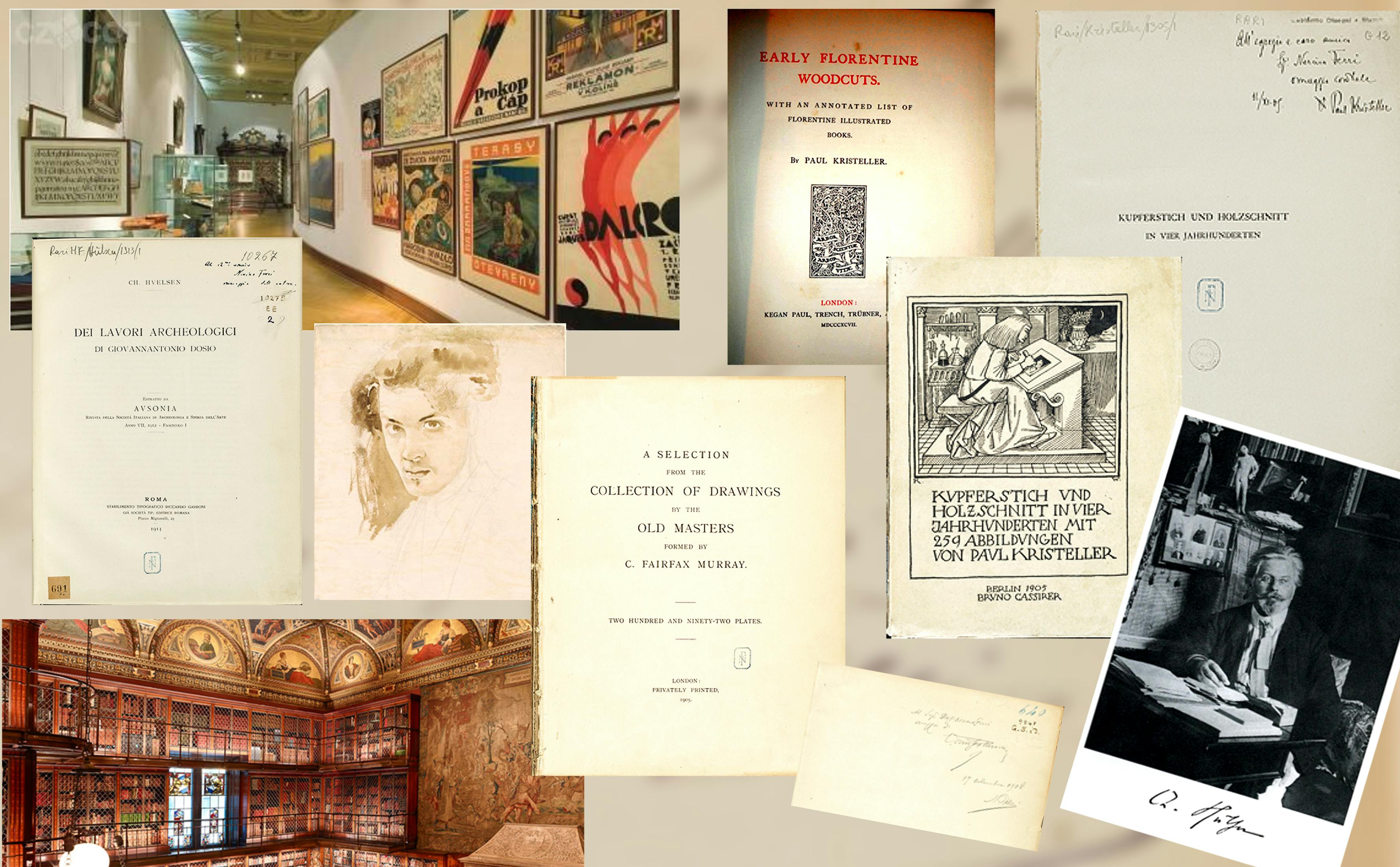
Another donor was professor Paul Kristeller, philologist and art historian, esteemed scholar of Italian typographical brands, who spent long periods in Italy in the 1890’s.
He was engaged to study the copper engraving collection of the painting Gallery in Bologna and to catalogue the prints and drawings collection in Rome.[87] He too stayed in Florence where he spent many months in the National Library, writing his book Early Florentine Woodcuts, published in London in 1897[88].
It’s quite possible that, during that period, Kristeller met Nerino Ferri. He dedicated some of his essays, published between 1896 and 1905[89], personally to Nerino, “with friendly greetings”.
The archaeologist and philologist Christian Hülsen (1858-1935) [90], author of a critical volume on Roman topography[91], was well-known by Nerino Ferri, who consulted him to complete the last section of his Indice geografico-analitico dei disegni di architettura[92], concerning Roman inscriptions[93].
In 1912 Hülsen published an essay on Dei lavori archeologici di Giovanni Antonio Dosio [94] and gave an extract to “my very best friend Nerino Ferri”, that was published the following year.
In the preface[95], Hülsen explicitly refers to the rearrangement of the prints and drawings collection of the Marucelliana Library, that Nerino Ferri had been working on in those years[96] and to one of Ferri’s essays, published in “Bollettino d’Arte” in 1911, in which Nerino Ferri attributed some Marucelliana drawings to Dosio[97].
On the 17th September 1908 the pre-Raphaelite painter and London art dealer Charles Fairfax Murray (1849-1919)[98] gave Nerino Ferri the first of two volumes of the catalogue of his large collection of drawings[99].
Fairfax Murray’s vast collection of drawings, including almost 1500 drawings by old European Masters from the end of the XIVth to the XVIIIth century, was purchased, after long negotiations, by the wealthy businessman and famous art collector John Pierpont Morgan (1837-1913) and went on to form the nucleus of the Department of Drawings of the Morgan Library in New York, the most famous drawing collection in the United States[100].
Fairfax Murray dedicated the catalogue of his important collection to “Professor” Nerino Ferri[101], underlining the “status” achieved by Ferri after years of working and studying with the Uffizi prints and drawings collection: the humble apprentice, considered suitable only for manual tasks, had finally become an esteemed professor.
[87] See FAIETTI 2014, p. 19. See also BALLANTI 1999, pp. 220-221 and FILETI MAZZA 2014, pp. 92-93.
[88] KRISTELLER 1897a.
[89] KRISTELLER 1896, see also Appendix, entry n. 18. KRISTELLER 1897, see also Appendix, entry n. 19. KRISTELLER 1898, see also Appendix, entry n. 20, KRISTELLER 1905, see also Appendix, entry n. 24.
[90] About Christian Hülsen see FILETI MAZZA 2014, pp. 72-73.
[91] HULSEN 1907.
[92] FERRI 1883.
[93] See FILETI MAZZA 2014, pp. 72-73.
[94] HULSEN 1913, see also Appendix, entry n 33.
[95] HULSEN 1913, p. 1.
[96] Ferri started working on the inventory of the prints and drawings collection of the Marucelliana Library in 1887 and, in a more systematic way, from 1906 to 1911. Ferri’s inventory is today “a fundamental tool for the analysis of the prints and drawings collection of the library”(ORBICCIANI 2007, p.250).
[97] FERRI 1911a.
[98] See PETRIOLI 2004, p. 42.
[99] FAIRFAX-MURRAY 1905-1912, see also Appendix, entry n. 26.
[100] see STAMPFELE 1974, p. XI; see also TAYLOR 1970, p. 39.
[101] FAIRFAX-MURRAY 1905-1912, see also Appendix, entry n. 26.
- 12/13The first temporary exhibition of prints by Francesco Bartolozzi
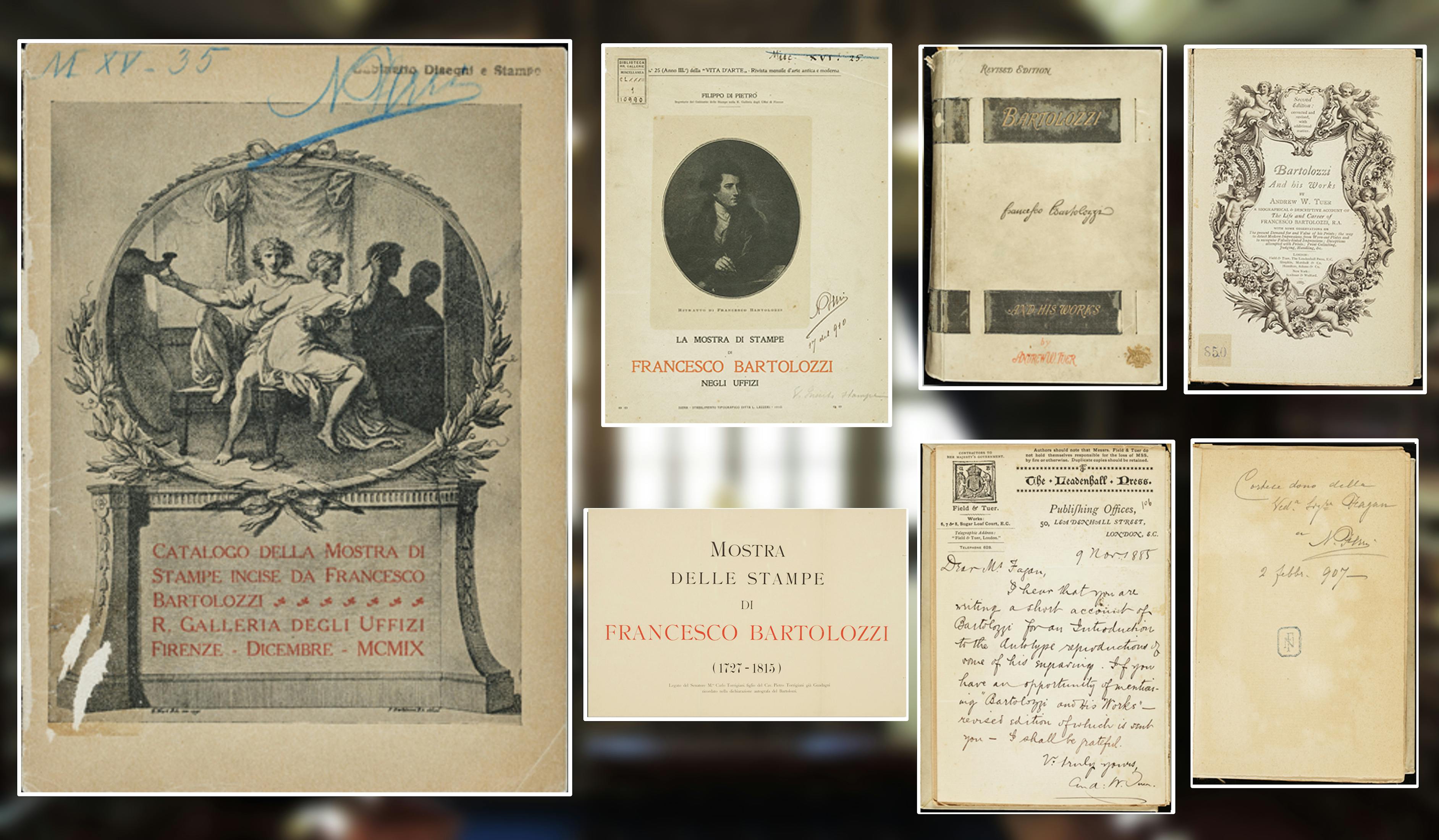
In 1909 the Uffizi prints and drawings collection was moved from a narrow, confined site[102] to the present location of the Prints and Drawings Department. This new, large site, with an annexed library, was located on the first floor of the Vasari Palace. Nerino Ferri and Filippo Di Pietro organised a temporary exhibition of Francesco Bartolozzi’s prints in the Department. The Bartolozzi exhibition ended a long season of drawings and prints permanently on show at the Uffizi Gallery until then.
Corrado Ricci[103], the new Superintendent of the Galleries of Florence from 1903 to 1906, was culturally sensitive and attentive to the needs of conservation of the frail prints and drawings. He promoted important and far-reaching changes in the organisation of the spaces and services offered by the Uffizi Gallery. In only three years he promoted a general revision order for all the Florentine museums and founded indispensable technical support services such as the Uffizi Photographic Cabinet, the Uffizi Library, the Works of Art Inventory Office and the Historical Archive[104].
Corrado Ricci provided the new site for the Prints and Drawings Department, winning over Ferri’s initial reservations[105]. He freed up the first floor of the Vasari Palace moving the collection of self-portraits in the new dedicated rooms onto the second floor of the Uffizi Gallery.
When he became the General Director of Antiquities and Fine Arts, from 1906 to 1919, Ricci worked hard to produce and pass the first protection act in the sector of cultural heritage in Italy[106].
As Ferri later wrote, when the Board of Antiquities and Fine Arts decided to stop the permanent exhibition of prints and drawings, Corrado Ricci’s position was undoubtedly very influential :
“Honourable Minister of Public Education, the Board for Antiquities and Fine Arts has deliberated that the prints and drawings should be removed from permanent exhibition, having discovered that the continuous action of the light has produced a significant deterioration in both”[107].
Nerino Ferri chose the artist for the first temporary exhibition of the Uffizi Prints and Drawings Department from an unconventional and original view point[108]. Francesco Bartolozzi was “a talented and spirited Florentine engraver from the XVIIIth. century”, who spent his best years in England and was renowned for his reproductions of the Old Masters “from Holbein to Guercino and from Reynolds to Kaufmann”[109].
The Uffizi Prints and Drawings Department owned a portfolio of 1000 Bartolozzi’s engravings of exceptional quality, together with a certificate of authenticity signed by the artist. This portfolio came into the Uffizi collection in 1865, through the legacy of Marquis Torrigiani[110].
Ferri could have chosen a more predictable theme to celebrate this special event, such as a famous Renaissance artist or a selection from the masterpieces of the Uffizi collection, but Ferri’s choice fell on a “more sophisticated, fashionable and international subject”[111].
The analysis of Andrew Tuer’s Bartolozzi and his works[112]- donated to Ferri by Louis Fagan’s widow on 1907, full of dedications and handwritten notes, helps us to better understand the reasons behind the choice of an artist at first sight so unusual.
Andrew White Tuer (1838-1890) was a well-known publisher, writer and art collector, founder of the historical London publishing house, Leadenhall Press[113]. Tuer wrote this book about the Florentine engraver Francesco Bartolozzi because Bartolozzi’s works met the taste of a wide audience at the time, as he explained, with a touch of humour, in the preface of his book:
“The fascination exercised on the present generation by these prints is hardly to be wondered at, for they are not only exquisitely beautiful in themselves, but, being the production of a past age, they boast the peculiar charme…of a time we can only imagine, that of our great-great-grandmothers; and they harmoniously accord with the prevailing taste for old-fashioned furniture. They are therefore delightful both in their taste and fashion” [114].
At the time, there was a thriving market for Bartolozzi’s engravings and it was very hard to distinguish a real Bartolozzi from a copy.
Most of his book is taken up giving precious advice to the potential customer. He also compared, in detail, Bartolozzi’s technique with his school’s technique and suggested auction houses that could ensure the purchase of an authentic Bartolozzi work.
In 1885 Louis Fagan, the then director of the Department of Prints and Drawings of the British Museum, worked on the publication of a collection of Bartolozzi’s engravings[115]. Andrew Tuer sent Fagan a special edition of his book, asking him to cite his book in the bibliography. Some years after Fagan’s death, in February 1907, Fagan’s widow gave Nerino Ferri this copy together with other books[116].
Nerino Ferri was well aware that Francesco Bartolozzi’s works met with the taste of art lovers of the time and in 1909, when he had to choose the subject for the first temporary exhibition of the Uffizi drawings, his choice of Bartolozzi’s engravings was probably not accidental.
In fact, by exhibiting Francesco Bartolozzi’s engravings, Nerino Ferri satisfied the dual purpose of both showing works of exceptional quality and presenting an artist who was highly appealing to the public, most of whom were English-speaking intellectuals, living in Florence at the time[117].
[102] See NOBILI 1910.
[103] See STROCCHI 2005, SICOLI 2007, MARINI 2014 and FAIETTI 2013, p. 384.
[104] See TAMASSIA 2011, p. 24.
[105] Corrado Ricci wrote “Dear Poggi…I enjoy hearing that the prints and drawings rooms are coming along well. Ferri will be convinced that I was right to insist, while he, who is hostile to new things, was doubtful..”, AGU, Archivio Poggi, Serie I, Carteggio, n. 113: C. Ricci a G. Poggi, “Roma, 3.XI.’09”.
[106] It’s the law n. 364 of the 20th. June 1909. To this regard, see SICOLI 2007, p. 519.
[107] FERRI/DI PIETRO 1909, p. 4.
[108] FERRI/DI PIETRO 1983, pp. 440-441.
[109] FERRI/DI PIETRO 1909, p. 4.
[110] C.PINI, Catalogue of the engraved prints by Francesco Bartolozzi (1865), GDSU, Fondo manoscritti, coll. n. 3, published in FILETI MAZZA 2014, Appendix XXIII; see also DI PIETRO 1910, Appendix, entry n. 30. Here Filippo Di Pietro published a photo of the certificate of authenticity written by Bartolozzi.
[111] PETRIOLI TOFANI 1983, pp. 440-441.
[112] Tuer 1885, see Appendix, entry n. 13.
[113] See Mc.LENNAN YOUG 2010.
[114] See TUER 1885, p. ii
[115] FAGAN 1885.
[116] FAGAN 1883, see Appendix, entry n. 8 and LIPPMANN 1887, see Appendix, entry n. 14.
[117] See BARDAZZI-SISI 2011 and SCIOLLA 1992, p. 274. A review of Bartolozzi’s exhibition was published also in English in FLORENCE HERALD 1910, see DI PIETRO 1919, Appendix, entry n. 30.
- 13/13Filippo Di Pietro, Nerino Ferri’s trusted collaborator
We know that Filippo Di Pietro (1875-1960) was assigned an official position in the Uffizi Gallery in 1922[118], but his collaboration with the Uffizi dates back as far as 1906, when Pasquale Nerino Ferri wrote the following note to Corrado Ricci:
“Dear Director, I am very grateful to you for the gentle care you have shown in allocating the new vice-secretary Filippo Di Pietro (from Rome) to this Cabinet, where he has already begun working. I will have him continue his work on the index file of categories of the drawings. He is full of goodwill and I trust he will make a good impression”[119].
The journalist Aldo Sorani, who met Di Pietro personally, describes him in these words :
The secretary of the Uffizi Cabinet, Filippo Di Pietro, is an art critic who, more than anyone, has shown how much can be learnt from the study of drawings and who has collaborated ardently with Ferri in the organisation of the Uffizi exhibitions. Di Pietro has been able to newly interpret and give voice to those drawings that he has been studying not only for his own benefit, but also in order to prepare the exhibitions with a lively spirit, a passion full of intellect and with eyes full of wit. The proof is in Di Pietro’s volumes on “Andrea Del Sarto’s drawings” [120] and “Federico Baroccio’s unknown drawings, still unidentified”[121], that are, in themselves, such a new contribution to our knowledge of Andrea and Baroccio, that both critics and art lovers should be eternally grateful[122].
Over time, Filippo Di Pietro became Ferri’s trusted collaborator in the organisation of the first temporary exhibitions and in the publishing enterprise of the so-called Olschki’s Portfolios[123], even if he still did not have a permanent position in the Department of Prints and Drawings.
However Filippo Di Pietro did try to consolidate his employment status at the Ministry, with great determination and energy.
In May 1914 he asked for leave of absence to finish his graduation thesis[124] which he presented in Urbino, on the 1st of December 1914[125]. At the same time he studied “day and night”[126] for the public exam for “inspector” at the Galleria Corsini in Rome, advertised in September of 1914[127].
In 1915 Filippo Di Pietro was obliged to ask for a transfer to Rome in order to help his family, affected by an earthquake[128]. The letters reporting this event are not dated, but the earthquake that Di Pietro refers to, could be the one that hit Marsica, a region of Abruzzo, on the 13th January 1915.
This earthquake was so violent that it caused damages also in Rome[129]. In fact, Filippo Di Pietro wrote from Rome on the 21st June 1915 “ despite all sorts of difficulties things are starting to go quite well, so that soon everything will be settled”[130].
But Filippo Di Pietro’s problems were not to end so soon : during 1916, he was suddenly called to the front to fight in the First World War.[131]
In an undated letter sent from the “military detachment of Bracciano”[132], Di Pietro wrote to Poggi that he had not been able to send the “promised manuscript”, as he had been suddenly recalled to the front, preventing him from “giving a correct form” to the text he had already written and, in another letter, datable to 1916, he emphasised: “I have not yet succeeded in writing those few notes for the facsimiles, rewritten many times, but in a way that I am still not satisfied with. I ended by tearing them up”[133].
Di Pietro was, probably, referring to the introduction to the last issue of Olschki’s Portfolios[134], on the Uffizi ornamental drawings, that Olschki was only able to publish in 1921, when he had completed the entire work. Poor Filippo Di Pietro, given his present situation, was undoubtedly unable to calmly concentrate on what Poggi asked of him and he wrote this moving letter to Poggi:
“Amongst the few papers I have brought with me, apart from the monographs on Andrea Del Sarto and Baroccio, I care a great deal about your letters, your postcards and the report of the examining board of the competition for the position of inspector at Galleria Corsini”[135].
On the wave of the general enthusiasm for Italy’s entrance into the war, Pasquale Nerino Ferri bought a small Calendario del soldato MCMXVI [136]. The purchase of this copy is not linked to Filippo Di Pietro’s departure for the war, as he left for the front a year after this booklet arrived in the library. Pasquale Nerino Ferri purchased this Calendario to contribute to the fund raising for the soldiers at the front.
At the onset of the First World War Di Pietro had been working side by side with Ferri for “over ten years”[137]. Unfortunately he was never to see him again as Nerino Ferri died in 1917, while Di Pietro was still fighting at the front.
After Di Pietro’s departure to the front and, above all, after Ferri’s death, there was a marked setback in temporary exhibitions. They restarted only in 1922, with the exhibition of XVIIth century drawings, curated by Odoardo Hylier Gigioli, Paquale Nerino Ferri’s successor in the Department of Prints and Drawings in the Uffizi Gallery.
[118] See SCUDERI 2007, pp. 227-228.
[119] BCR, Archivio Ricci, n. 12602: “Firenze, 30 maggio ‘906”.
[120] DI PIETRO 1910a.
[121] DI PIETRO 1913.
[122] SORANI 1913.
[123] DISEGNI DELLA GALLERIA 1912-1921. See BASAGNI 2017.
[124] AGU, Archivio Poggi, Serie I, Carteggio, n. 6, 294: F. Di Pietro to G. Poggi, “Urbino, 24 maggio 1914”.
[125] BCR, Archivio Ricci, n. 11358: Letter from F. Di Pietro to C. Ricci, “Urbino, 1 December 1914”, where he cites the title of his thesis:“The legal protection of works of art in Italy and under Roman Law”.
[126] “…I am working night and day to prepare the presentation of my graduation thesis and for the competition exam in Rome and maybe the one and the other will happen almost simultaneously (10-25 November””, BCR, Archivio Ricci, n. 11359: “F. Di Pietro to C. Ricci, “Firenze, 22 ottobre 1914”.
[127] Referring to the news of a competition based on “qualifications and examinations” for the position of “inspector” at the Galleria Corsini in Rome, see CRONACA DI BELLE ARTI 1914. Corrado Ricci wrote to Giovanni Poggi that the Ministry of Education had to “postpone the competition due to the outbreak of the first World War” (AGU, Archivio Poggi, Serie I, Carteggio, n. 17, 221: C. Ricci to G,. Poggi, “Rome, 8 luglio 1915”).
[128] AGU, Archivio Poggi, Serie I, Carteggio, n. 6, 301 and 310: F. Di Pietro to G. Poggi, from Rome.
[129] See INGV 2015 and CASTENETTO GALADINI 1999.
[130] AGU, Archivio Poggi, Serie I, Carteggio, n. 6, 295: F. Di Pietro to Giovanni Poggi.
[131] “This is the second year I begin in the warzone”, AGU, Archivio Poggi, Serie I, Carteggio, n. 6, 297: F. Di Pietro to G. Poggi, “Warzone, 2nd January 1918”, so the recall to the front has to be placed during 1916. Filippo Di Pietro left for the front with the continuing concern that the Ministry could give his position to another person, without considering the suspended competition /AGU, Archivio Poggi, Serie I, Carteggio, n. 6, 298: F. Di Pietro to G. Poggi, “Warzone, 19th June 1918”).
[132] AGU, Archivio Poggi, Serie I, Carteggio n. 6, 302: F. Di Pietro to G. Poggi: “Detachment of Bracciano”, without date.
[133] AGU, Archivio Poggi, Serie I, Carteggio, n. 6, 306 : F. Di Pietro to G. Poggi, defined as “secret”, without date. The letter is datable to 1916, thanks to a particular reference in the text. Filippo Di Pietro went on writing : …Prof Pernier has been here. He complained to me that he didn’t have an accountant and secretary. The idea to being able to come back in Florence appealed so much to me, that I would have quite willingly offered my services to him….”; Luigi Pernier was appointed Director of the Archaeological Museum in Florence in 1916 (see BERUTTI 2009, pp. 69-77).
[134] DISEGNI DELLA GALLERIA 1912-1921.
[135] And he added: “Five years have passed since then!”, AGU, Archivio Poggi, Serie I, Carteggi. N. 6, 297, F. Di Pietro to G. Poggi, from “Warzone, 2nd January 1918”.
[136] CALENDARIO 1916, see also Appendix, entry n. 39.
[137] AGU, Archivio Poggi, Serie I, Carteggio, n. 6, 304 : Filippo Di Pietro to G. Poggi, without date, but posted in 1917, because Di Pietro mentions that he has heard of Ferri’s death.



«The World of Yesterday»: Rare Book Collection of the Library on view
INTRODUCTION
This exhibition is a tribute to the memory of Pasquale Nerino Ferri (1851-1917), the first “director” of the Prints and Drawings Department of the Uffizi Gallery, on the occasion of the centenary of his death. His private collection of books, now available in the Uffizi Library, is a true witness to “the world of yesterday” or, rather, “the world of the day after yesterday”, that is brought back to life in the animated details of these books. These thirty-nine books tell us the fascinating story of Pasquale Nerino Ferri in the Uffizi Gallery, through the analysis of his handwritten notes and the dates and dedications written by his correspondents from all over the European continent.
Ferri began his activity in the Uffizi in 1871, during a substantially optimistic era, known for its passionate and scientific study of Art. At the end of his life he was compelled to watch the destruction of that world as the first world war erupted, and to bid adieu to Filippo Di Pietro, his personal assistant, called to the front.
CREDITS
Author: Carla Basagni
Curators of the graphics: Eleonora Belpassi, Chiara Benvenuti
Graphic design and editor of the virtual exhibition: Simone Rovida (ICT, Digital Strategies and Cultural Promotion Dept.)